
Metal Shelter or Reinforced Concrete Structure?

When it comes to protecting people, the key question is not only whether a shelter can withstand an impact, but also how quickly it can be delivered, installed, and adapted to a specific site. That is why more and more businesses, municipalities, and private customers are choosing modular steel shelters.
Steel vs. reinforced concrete: the same level of protection, different capabilities
Many people assume that concrete provides superior protection. In reality, the level of protection depends not on the material itself, but on a properly engineered structure.
For a steel shelter, the critical factors are:
- Wall thickness (for armored steel, 2–6 mm may be sufficient)
- A properly designed system of reinforcing ribs
- A structural design that evenly distributes impact loads
For reinforced concrete shelters, the equivalent factors include:
- Concrete walls at least 30 cm thick
- Reinforcement designed in accordance with engineering standards
- An additional internal protective layer to prevent secondary concrete fragments (spalling)
As a result, steel and reinforced concrete shelters designed to the same protection class typically have comparable costs, but differ significantly in terms of practicality and operational performance.
Compact dimensions without compromises in security
To achieve the required level of protection, reinforced concrete shelters require thick walls that occupy a significant amount of space. Their construction method also makes them less economically efficient when the goal is to protect small groups of 4–8 people.
A steel structure provides the same level of protection with much thinner walls, allowing you to:
- Maximize usable interior space
- Install shelters where available space is limited
- Make more efficient use of industrial or commercial sites
Many of our shelters have been installed within existing spaces without requiring any modifications to the surrounding buildings. In some cases, shelters have been placed directly next to production lines, allowing workers to reach safety within literally one minute after an air raid siren is activated.
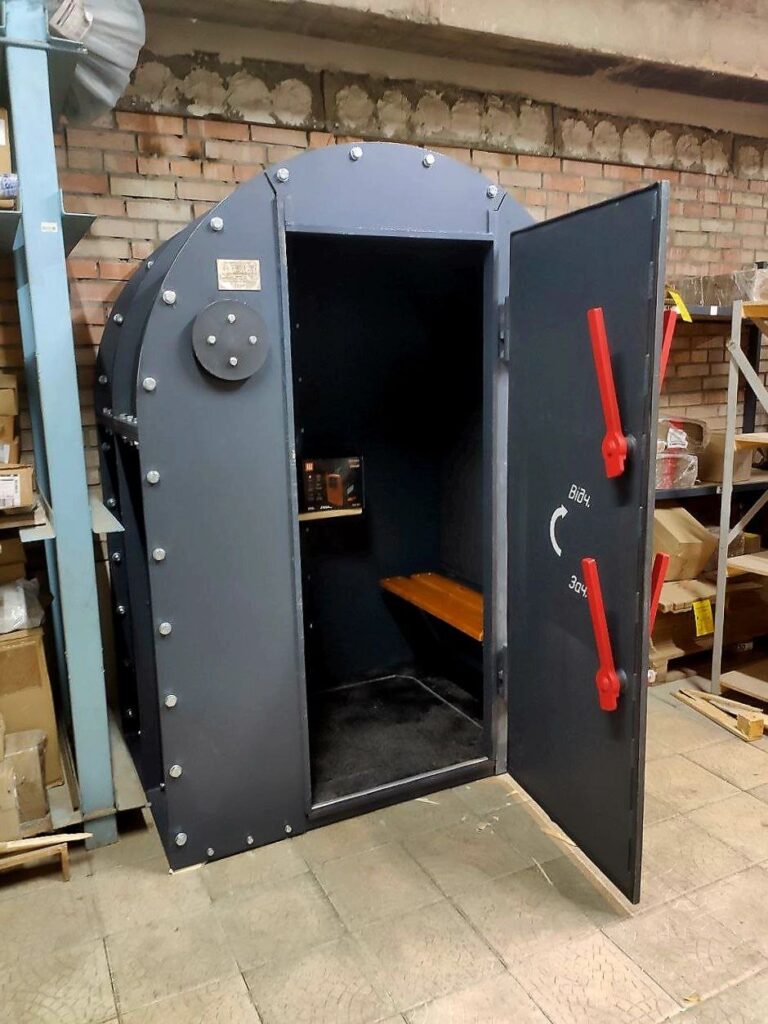
The “Boomie Light” model installed for warehouse personnel
Lower weight means greater flexibility
One of steel’s greatest advantages is its significantly lower weight.
This provides several important benefits:
- Easier transportation
- Faster installation
- The ability to install shelters where heavy concrete structures would be impractical or economically unjustified
- The option to dismantle, relocate, and reuse the shelter if operational needs change
A reinforced concrete shelter effectively becomes a permanent structure, whereas a steel shelter remains a movable asset. Even if the main building is destroyed, the shelter can be relocated to another site and continue to provide protection.
Eliminating the risk of secondary fragments
Under severe impact loads, reinforced concrete can produce internal chips and fragments (known as spalling), creating an additional hazard for people inside the shelter.
Steel structures do not generate secondary fragments in the same way. Under impact, steel behaves differently, making this one of the key advantages of steel shelters over reinforced concrete designs.
Why customers choose Zalizna Volya™ steel shelters
- High level of protection, validated through testing and real-world operation
- Smaller footprint while providing the same level of protection
- Significantly lower weight than reinforced concrete structures
- Fast transportation and installation without extensive construction work
- Can be dismantled, relocated, and reinstalled
- Modular design that can be customized to meet specific requirements
- Long service life with the possibility of future upgrades
How to choose the right shelter model
Contact us by phone or submit an inquiry. Our specialists will discuss your requirements, the intended operating conditions, and the number of occupants. Based on this information, we will recommend the most practical and cost-effective shelter solution for your needs.